
Is Seeing Believing? The Inconsistencies in NextNav’s “Coexistence” Charade

In the article “Seeing Is Believing,” posted on the NextNav website on May 21, 2026, NextNav claims that they demonstrate coexistence with Part 15 security devices. Here’s what we do know: the “test” (which can be better characterized as a publicity stunt) occurred on the roof of 10 South Almaden Boulevard in San Jose, California. The NextNav team claims to show a carbon monoxide detector and panic button roughly 20 feet away from a typical 65-degree bandwidth cellular antenna with a radiohead below it. They claim that said radiohead is transmitting at “high power” while the carbon monoxide detector and panic button operate flawlessly.
This charade demonstrates the sheer lack of credibility from NextNav in their treatment of Part 15 Lower 900 MHz devices. As for what we don’t know, the blog post does not contain a single technical parameter for how the test was conducted. NextNav claims that it operated at “high power,” but does not give a value for the transmit power of the base station. There is a generic picture of the NextNav downlink showing a broadband channel centered at 923 MHz; however, it is not clear where this picture was taken. While showing the spectrum, there is one key feature missing: the presence of any narrowband 900 MHz traffic. If this “test” was truly conducted in the Lower 900 MHz band, one would expect a large amount of traffic, such as the spectrum capture below that was made in the Pericle Communications offices. That leads us to question whether NextNav’s picture was even made from the rooftop in San Jose or if it was made in a lab setting and disingenuously portrayed in their video.
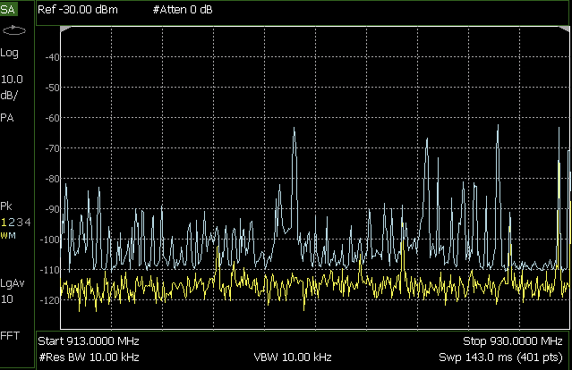
The test has countless other flaws that render NextNav’s conclusion moot. First and foremost of these is that NextNav does not give the models of devices allegedly tested. This would be the most basic of details to provide, and would give any technically-minded reader much more insight into what is happening in the test. Why does NextNav show only the 5G downlink while not also showing that the victim devices are also transmitting in the 900 MHz band? For all a we know, these devices could easily be in the 2.4 GHz or 5.8 GHz bands.
Second, what is the power out of the antenna? Time and again, NextNav has used duty cycle and loading factor to justify their erroneous conclusions, while conflating the two terms. Has the duty cycle or loading factor of this radiohead been altered to produce an unrealistic 5G channel? At 0:58 of the video within the blog post, it is apparent the 900 MHz repeater entirely lost its connection with the carbon monoxide detector with no explanation given, further leading us to believe that this test has been distorted.
A proper test of coexistence should be done in a controlled environment, not on a rooftop. In other filings on the docket, NextNav has shown that they have the equipment to perform such a test. This raises the question of why this alleged San Jose test was not done in a controlled lab setting with participation from the actual manufacturers of the victim equipment, or transparent specs. A rational observer can only conclude that it was done in this manner to obfuscate details and provide illegitimate results, leading us to our final question: why are we allowing the NextNav petition to remain in consideration as its defenders and advocates refuse to provide adequate technical information, and post inadequate and misleading test results, attempting to drown out the numerous reliable technical studies on file proving the interference concerns raised by their opponents? It is time for the Federal Communications Commission to put this matter to bed, denying the NextNav petition and moving toward the consideration of the many other viable position, navigation and timing alternatives.
Michael McGinley is a senior systems engineer at Pericle Communications Commission.
Want more on this topic? Check out SIA’s resources on the Lower 900 MHz band issue here.
 Back to Top