
AI Hype vs. Reality in Retail Security
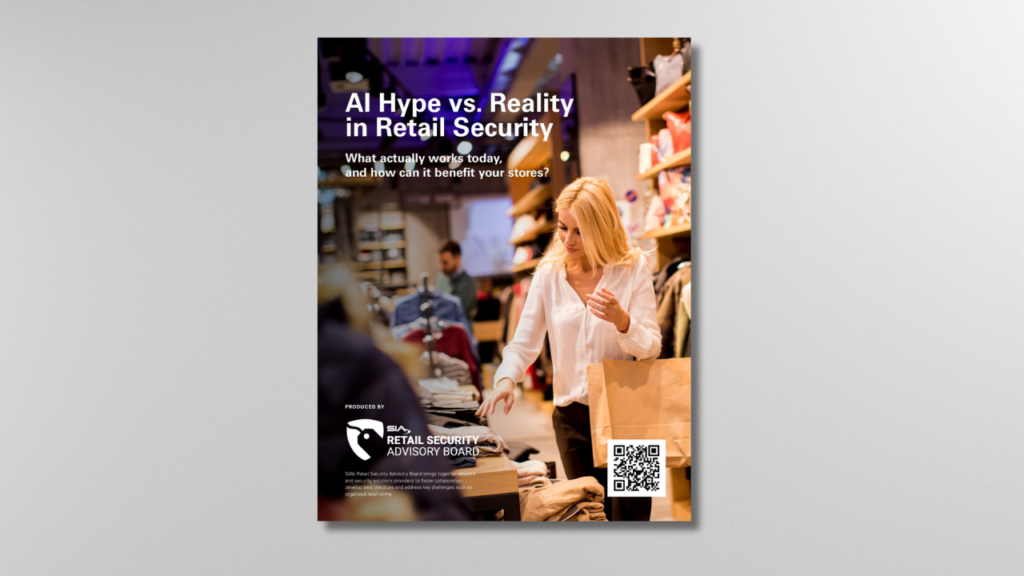
What Actually Works Today, and How Can It Benefit Your Stores?
About the Report
 Artificial intelligence (AI) is one of the most talked-about technologies in retail operations and security today and one of the most misunderstood. Headlines promise transformation, technology and solution suppliers promise precision, and internal stakeholders are asking a simple question: What actually works, and how does it impact our stores today?
This paper was developed by the Security Industry Association (SIA) Retail Security Advisory Board to cut through the noise. The purpose is to provide asset protection, store operations and technology leaders with a clear, practical understanding of basic AI terms and highlight how AI is being used in retail environments today, where it delivers real value, where it falls short and how to evaluate it responsibly.
The goal of this paper is not to promote the hype or position AI as a replacement for retail teams. AI is not a future-state concept—it is already embedded in many retail environments today. Instead, this resource is designed to provide a grounded, real-world perspective on how AI can serve as a practical tool when paired with clear business objectives, strong workflows and realistic expectations.
Select Key Takeaways
 AI is no longer an emerging concept in retail security—it is already helping retailers reduce shrink, improve operational visibility and safeness, enhance customer experiences and make better informed decisions. The most successful deployments, however, are not necessarily the most advanced—they are the ones aligned to clear business objectives and supported by strong operational processes.
Retailers evaluating AI solutions should be focused less on marketing claims and more on measurable outcomes. The most valuable question is not “What is the latest AI can do?” but rather “What problem does it solve?” or “How will we measure success?”
The future of retail security will increasingly be shaped by intelligent systems capable of delivering greater visibility, faster response times and actionable insights.
Organizations that approach AI with realistic expectations, clear objectives and a commitment to continuous improvement will be in the best possible position to capitalize from the benefits.
The question is no longer whether to utilize AI—it is “How can I learn to leverage it responsibly, effectively and in ways that create the most value for my organization?”
Key Takeaways for Retail Leadership
 Focus on business outcomes, not AI features. The most successful AI deployments are the ones that solve a specific operational or loss prevention challenge.
- AI should help augment teams, not replace them. Human judgment and verification are a critical step for investigations and response to an event.
- Competitive advantage comes from execution, not just adoption. Simply deploying AI or a new analytic does not create Organizations that align that technology with people, processes and clear objectives will always see the greatest return on investment.
Key Takeaways for Integrators
 Become a strategic advisor, not just a technology provider or reseller. Help retailers identify the right use cases for AI by understanding their operational goals, challenges and existing workflows.
- The greatest benefits come from connecting AI with video management systems, POS, smart LED or lighting, access control and other business systems. AI is not a standalone solution.
- Camera placement, quality, infrastructure and user adoption all influence the success of any new system. A successful deployment requires planning, ongoing maintenance and adjustments and continued customer education.
Key Takeaways for Suppliers
 Be transparent about capabilities, expectations and limitations. Nothing can ruin a new project faster than disappointing outcomes from exaggerated capabilities.
- Demonstrate measurable business value. Retailers are investing in outcome, not technology on its own. Show how your solution improves operations, reduces shrink, enhances employee and customer safety and increases efficiency with existing staff.
- Prioritize an integrated system. Solutions that integrate with existing store technology have a much higher adoption rate than standalone solutions.
Key Takeaways for Corporate Stakeholders
 Help educate, not just advocate. You know what the problems your store and management are facing more than Educate people on how a new integrated solution can make a positive impact on that specific problem.
- Crawl, walk, run. Start slowly, even after success at one location. Make sure you can work out the kinks, hiccups or any other small issues before rolling out to more locations.
- Lead the conversation with facts, not hype. Unfortunately, there is no miracle solution. Your store is unique, even if the problems you’re facing are not. It’s important to stick to facts on what this new solution can tackle, and your expectations if it’s implemented.
SIA’s Retail Security Advisory Board brings together retailers, security solution providers and technology leaders to collaborate on retail’s most pressing security challenges, including AI in retail security, organized retail crime (ORC), data integration and technology adoption. With diverse members, the board provides a 360-degree perspective across strategy, operations, technology and risk management. Through thought leadership, best practices and topical papers, the group identifies high-impact industry challenges that require collective action, seeks to accelerate the adoption of innovative and effective security solutions and shapes practical recommendations and best practices for the retail security community.
 Back to Top