
Applying CPTED to the Perimeter: Insights From Perimeter PREVENT 2026
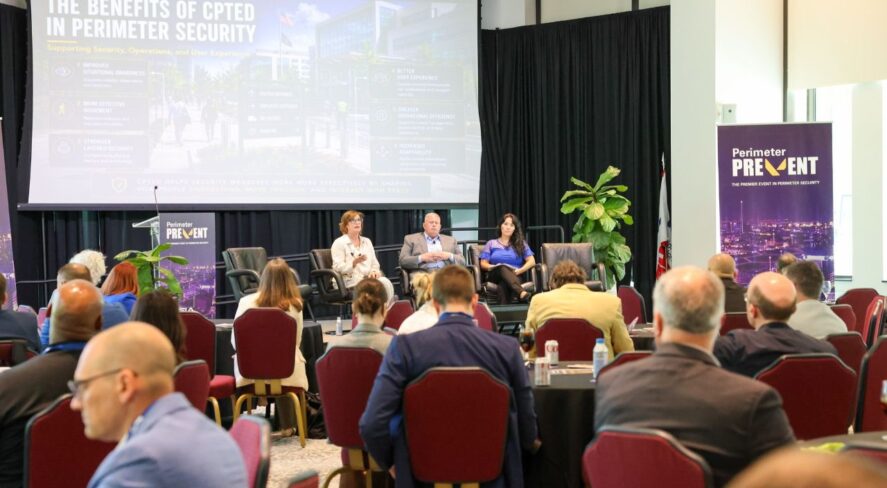
Experts discussed how the industry is rethinking boundaries in a changing security landscape.
Perimeters have traditionally been defined by physical barriers such as fencing, bollards, and controlled access points. While these elements remain important, today’s environments increasingly include shared public-private spaces, fan zones and transitional areas often referred to as “Zone X,” where boundaries are less defined.
At the 2026 Perimeter PREVENT conference, in a session moderated by Joelle Hushen, founder and president of the National Institute of Crime Prevention, experts Melissa Dominguez, founder of Dominguez Urban Strategies; and Herb Ubbens, president of Paratus Consultants Group, discussed how crime prevention through environmental design (CPTED) applies to perimeter security from a public safety perspective, including the what, why and benefits of applying CPTED to evolving environments, real-world examples of how they are used in daily operations as well as permanent and semipermanent applications and how CPTED supports more effective, adaptable and user-informed perimeter strategies across a range of settings.
What is CPTED, and Why Does It Matter in Perimeter Security?
Crime prevention through environmental design is the intentional use of the built environment to influence behavior, reduce opportunities for crime and support safety, security and legitimate use of space.
“CPTED is not a single solution—it’s a framework that helps people, places, operations and security measures work together,” said Hushen. “All these principles can be woven together to make a space safer.”
The panelists discussed how design influences visibility, movement, behavior and access before technology is engaged. CPTED can help spaces have:
- Improved situational awareness: Clear sightlines and activity support detection and response.
- More intuitive movement: People understand where to go and how to get there.
- Reduced concealment opportunities: Open, well-lit environments limit opportunities for misuse.
- Stronger perimeter effectiveness: CPTED reinforces barriers, technology and operations.
- Better user experience: Safer, more welcoming spaces encourage legitimate use and community trust.
Ubbens discussed how CPTED works alongside physical security, operational planning, technology, training and communication to create safer places and stronger outcomes.
Security Through Design: Where CPTED Meets Perimeter Protection
CPTED has four core principles:
- Natural surveillance—see and be seen. Visibility, sightlines, lighting and activity support awareness and detection.
- Natural access control—guide movement intentionally. Entrances, pathways, wayfinding and access management influence movement.
- Territorial reinforcement—communicate ownership and purpose. Identity, boundaries, stewardship and legitimate use strengthen space ownership.
- Maintenance—signal, care, order and oversight. Clean, maintained environments communicate management and reduce opportunities for misuse.
“We want spaces to be safe but also FEEL safe,” said Ubbens. “Applying CPTED in public safety and counterterrorism, we see that many of these things can be integrated into a holistic approach to perimeter security.”
Ubbens discussed how CPTED principles can be applied to the counterterrorism objectives of Deter, Detect, Delay, Respond and Recover:
- Deter: Visible and integrated design discourages criminal and terrorist activity.
- Detect: Improved visibility and natural surveillance support early identification of threats.
- Delay: Access control and physical design slow own and channel threats.
- Respond: Clear sightlines and predictable spaces enable effective response and evacuation.
- Recover: Resilient, well-designed spaces support community recovery and continuity of operations.
Combining the CPTED principles and counterterrorism objectives enhance physical protection, threat reduction, situational awareness and public acceptance and create safe, resilient, welcoming spaces.
How CPTED Is Applied on the Perimeter
Dominguez shared how, as a landscape architecture expert, she translates CPTED into spaces people can “see, understand, use and trust.”
“The perimeter is more than fences and barriers-,” she said. “It includes entries, sidewalks, plazas, fan zones, public-private edges and transitional spaces. Landscape architecture shapes movement, perception and behavior … before technology even turns on.”
Dominguez shared examples of design projects that have improved security using CPTED principles—including a park gateway that was transformed using enhanced visibility and lighting, a multifamily setback that was overhauled to create activation and ownership of the space and a park edge/plaza that was improved using edges and circulation.
“Planting, lighting, access and amenities help spaces feel safer and work better,” she said.
How CPTED Drives Value
Dominguez shared how CPTED principles can help create not just safety, but also beauty and return on investment. With CPTED, she said, spaces will see a $11 return per $1 invested, compared with only a $4 return on $1 invested without CPTED.
Using landscape architecture and CPTED for perimeter security results in higher value, more park use and a stronger economy, by providing amenities like more welcome entries, less concealment and better lighting.
“Safety is not a cost—it’s a value driver,” Dominguez said. “Landscape architecture makes the perimeter visible, intuitive, active and valuable.”
Learn more about Perimeter PREVENT here. And access more perimeter security content and resources from SIA here.
 Back to Top