
Expo Seguridad México Keynote Speaker Brian Allen Examines How Security Leaders Must Evolve in an AI-Transformed World
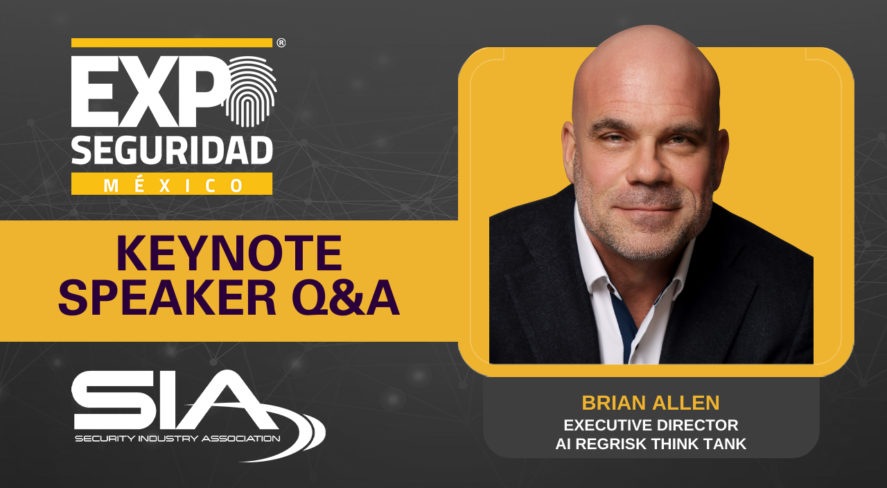
Expo Seguridad México is coming up June 2–4 in Mexico City, Mexico, and the Security Industry Association (SIA) is proud to be the premier sponsor of this fast-growing security expo, the largest event for the security industry in Latin America.
The Expo Seguridad México team have unveiled the SIA Education@Expo Seguridad México conference program, which includes a dynamic keynote and engaging, informative presentations from top industry expert speakers on the most current business trends, technologies and industry developments.
Among the robust lineup of conference sessions is a keynote presentation from Brian Allen, executive director of AI RegRisk Think Tank. SIA spoke with Allen to get a sneak peek at his session and hear from him about the impact of artificial intelligence (AI) on the security industry.
How is the “AI era” shifting our industry and what must security professionals prioritize?
Brian Allen: AI is changing business at a speed most organizations have never experienced. It is reshaping how companies make decisions, serve customers, manage risk and operate, all at once. For security professionals, this is not just a technology shift. It is a business transformation, and the organizations that treat it that way will be the ones that thrive.
The core principle still holds: you cannot protect what you do not govern. But the application has to evolve. AI is not a system we lock down—it is a capability being woven into every part of the business, often faster than leadership can track. The disruption is real, and where this technology is heading is still uncertain. That uncertainty is exactly why security leaders need to step up, not as gatekeepers, but as strategic partners helping the business adopt AI with confidence and resilience.
The priority for security professionals is to become the team that helps the organization move faster, not slower. That means building governance programs and a culture that can absorb change, defining accountability so decisions do not stall and being willing to take informed risks on behalf of the business. We need to position security as the function that enables responsible adoption. If this feels different from how we have approached past technology shifts, it is because this is different. The question every security leader should be asking is: what are we doing differently? Because if the answer is nothing, we are already falling behind.
Why must organizations evolve their governance strategies in the current technology landscape?
BA: Because what most organizations call “AI governance” is not actually governance. An organization stands up an AI committee, publishes responsible AI principles, and believes the job is done. But none of that answers the question leadership actually needs answered: Are we in a position to make informed decisions about AI, and are we finding the right balance between risk and reward?
No board confuses running the accounting department with overseeing financial integrity, yet most organizations today are treating AI governance as if managing the technical controls is the same as having enterprise oversight (it is not). Globally, regulators and legal frameworks are accelerating this distinction. The expectation is clear, and it is converging across jurisdictions: organizations deploying AI need structured systems that connect AI activity on the ground to leadership accountability at the top. The organizations most exposed right now are not the ones without AI policies—they are the ones with extensive AI activity and no oversight system tying it together.
What’s one tip you can share for businesses as they plan their approach for the year ahead?
BA: Govern the oversight system, not the technology. We do not need to understand how a large language model works to govern AI effectively. We need to know what decisions our organizations are making with AI, who is accountable, what information leadership needs and whether someone is verifying the system works. And we need to build a culture that can withstand change, because the technology is not slowing down.
Good governance is an accelerant, not a constraint. Organizations with clear accountability and structured oversight deploy AI faster and with more confidence, because they have the architecture to say yes when the risk is understood. There is so much downside talk around AI, but this is an enormous opportunity if approached the right way.
Start with five questions:
- Where are we using AI?
- Who is accountable?
- What is our risk appetite?
- Is leadership getting the information it needs?
- Is the strategy returning results?
If you can answer those with evidence, you are ahead of the vast majority of organizations. If you lean in, there is real opportunity here. If you stand still, you will fall behind. The technology will keep changing. Our willingness to approach it differently is what will set us apart.
You can access the full SIA Education@Expo Seguridad México conference program by registering on the show website; and use SIA’s link to save 20% on your education pass and access the show floor for free! We hope to see you there.
The views and opinions expressed in guest posts and/or profiles are those of the authors or sources and do not necessarily reflect the official policy or position of the Security Industry Association (SIA).
 Back to Top