
SIA New Member Profile: Datacast Technologies
New Security Industry Association (SIA) member Datacast Technologies is advancing Operational Trust Architecture (OTA)—the next architectural evolution of Zero Trust for critical infrastructure. The company is headquartered in Boise, Idaho, with executive leadership based in Huntsville, Alabama, and founding team members distributed across the United States and the United Kingdom.
SIA spoke with Tommi Robison, chief strategy and commercialization officer at Datacast Technologies, about the company, the security industry and working with SIA.
Tell us the story of your company.
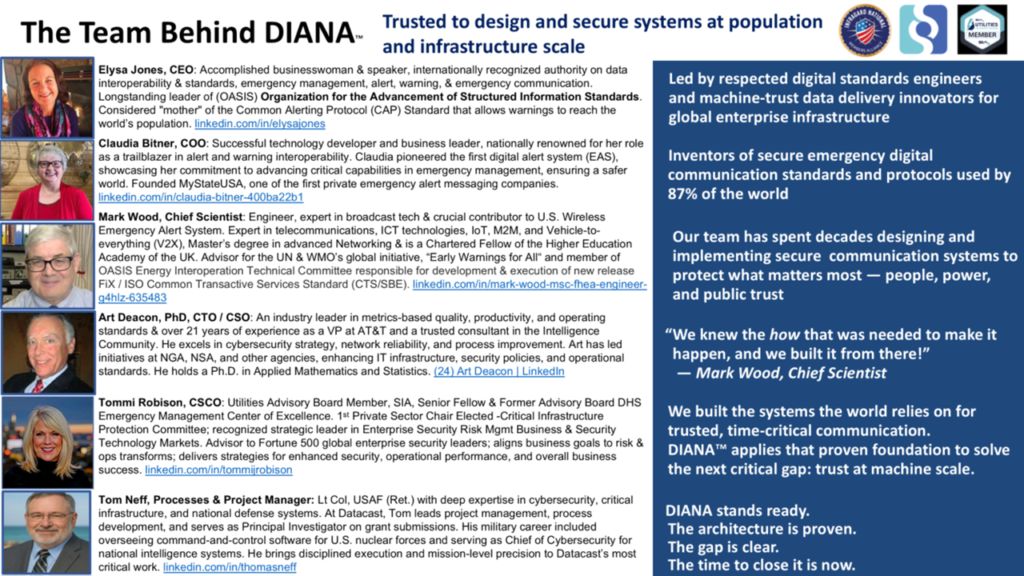
Tommi Robison: As critical infrastructure evolved toward artificial intelligence autonomous systems and highly distributed operational environments, it became clear that identity, access and session security alone were no longer sufficient. Operational systems require persistent validation of machine-to-machine commands before physical actions occur. Recognizing that this architectural gap would continue to widen, Datacast Technologies developed Operational Trust Architecture (OTA) and DIANA Machine Trust to extend Zero Trust principles to the operational device and data layers.
Our team has spent decades designing trusted communications, architecting interoperability standards and advancing emergency coordination systems operating at national and global scale. Today, we continue to help shape international standards supporting critical infrastructure communications and emergency alerting at population scale. That experience provided a unique perspective on the emerging operational trust gap as AI, automation and machine-to-machine operations accelerated across critical infrastructure.
What solutions/services does your business offer in the security industry? And what makes your offerings/company unique?
TR: Datacast Technologies is advancing Operational Trust Architecture, extending Zero Trust principles beyond identity, access and session management to the operational device and data layers where machine-to-machine commands control physical outcomes across operational technology (OT), industrial control systems (ICS), Internet of Things and critical infrastructure operating at machine speed and machine scale.
Through DIANA Machine Trust, Datacast persistently authenticates and validates machine-to-machine commands before execution, enabling cyber-informed engineering, Secure by Design principles and resilient operations without relying solely on continuously exposed devices, persistent reachability or communication-intensive polling architectures.
As AI, autonomous systems and distributed operational environments continue to scale, identity, access and session security alone are no longer sufficient. Operational systems must also persistently authenticate and validate machine-to-machine commands before physical actions occur. OTA addresses the increasingly visible operational trust gap between identity-based security and trusted machine operations.
What is something we might not know about your company—or something new you are doing in security?
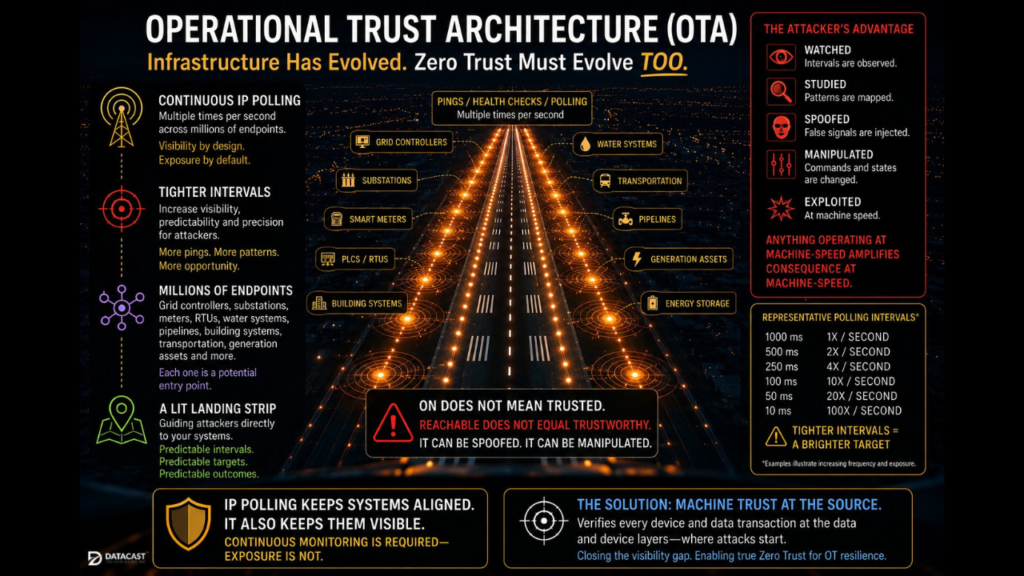
TR: One of the first operational advantages enabled by DIANA Machine Trust is what we call “shifting polling out of harm’s way.”
Today, continuous monitoring across critical infrastructure largely depends on polling, persistent connectivity and continuously exposed devices to maintain operational awareness. As AI, autonomous systems and connected infrastructure scale to millions of endpoints, that communications model increases cyber exposure, communication overhead, latency, operational fragility and operating expense.
DIANA Machine Trust persistently authenticates and validates machine-to-machine commands before execution, enabling trusted operations and continuous monitoring without sole reliance on communication-intensive polling architectures or continuously exposed devices.
As cyber threats accelerate, the industry’s response has largely been more monitoring, more telemetry, more polling and more analytics. While each improves visibility, together they also increase communication overhead, continuously exposed infrastructure and operational complexity.
Until now, continuous monitoring has required continuous exposure.
Continuous monitoring is necessary. Continuous exposure is not. DIANA Machine Trust makes that possible.
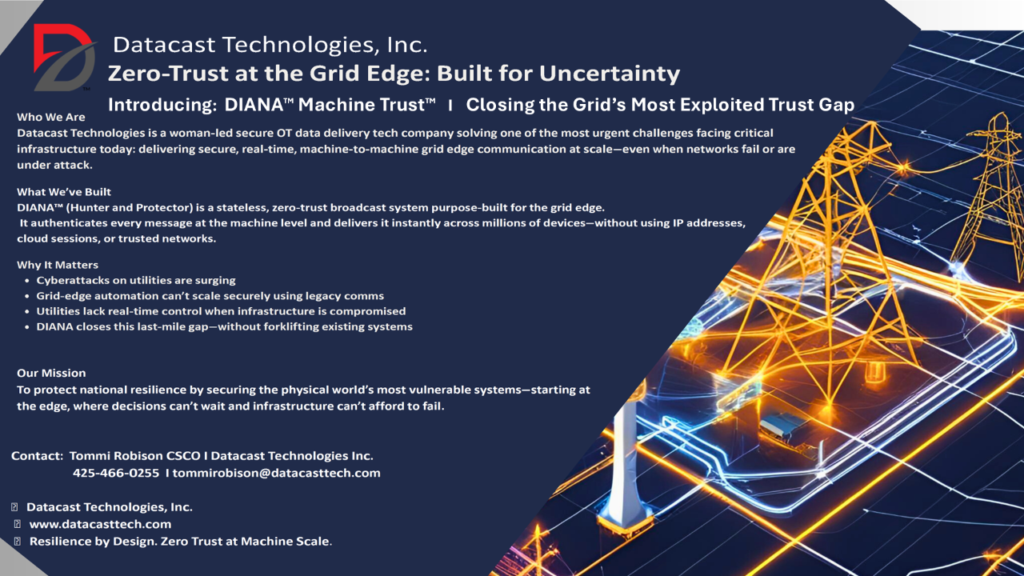
Another major focus is Pricing at the Edge—securely enabling machine-scale coordination and transactive energy services across the modern grid. DIANA helps close the operational trust gap supporting distributed energy resources (DER), advanced metering infrastructure (AMI), grid modernization initiatives and emerging transactive energy markets. Our work aligns with the emerging OASIS Energy Interoperation Common Transactive Services/Single Binary Encoding (CTS/SBE) standard, helping lay the foundation for trusted grid-edge coordination and commerce.
What does SIA offer that is most important to you/your company? And what do you most hope to get out of your membership with SIA?
TR: is being defined at the convergence of cybersecurity, IT/IP, operational technology, critical infrastructure resilience, business continuity, emergency management and physical security—the ecosystem SIA uniquely brings together.
As AI, automation, autonomous systems and machine-to-machine operations accelerate across critical infrastructure, we believe the industry is entering an important architectural transition toward operational trust, cyber-informed engineering and Secure by Design principles at machine speed and machine scale.
We value SIA’s leadership and its ability to convene the organizations shaping the future of security, standards and critical infrastructure. We look forward to contributing to those conversations, learning from fellow members, and building relationships that bridge cybersecurity, operational technology, standards and critical infrastructure to advance resilient, trusted operations that better protect people, processes and the critical systems on which society depends.
The views and opinions expressed in guest posts and/or profiles are those of the authors or sources and do not necessarily reflect the official policy or position of the Security Industry Association.
 Back to Top