
Fortifying the Perimeter: Next-Generation Intrusion Detection Insights From Perimeter PREVENT 2026
Experts Examined Digital Twins, LiDAR, Thermal and Intelligent AI Video
Most organizations believe their perimeter is secure—cameras are deployed, sensors are active and alerts are configured. Yet critical gaps remain. Movement occurs between zones, threats develop outside traditional fields of view, and by the time an alert is triggered, the situation has often already escalated. Facilities think they have their perimeter covered—but coverage doesn’t always mean visibility.
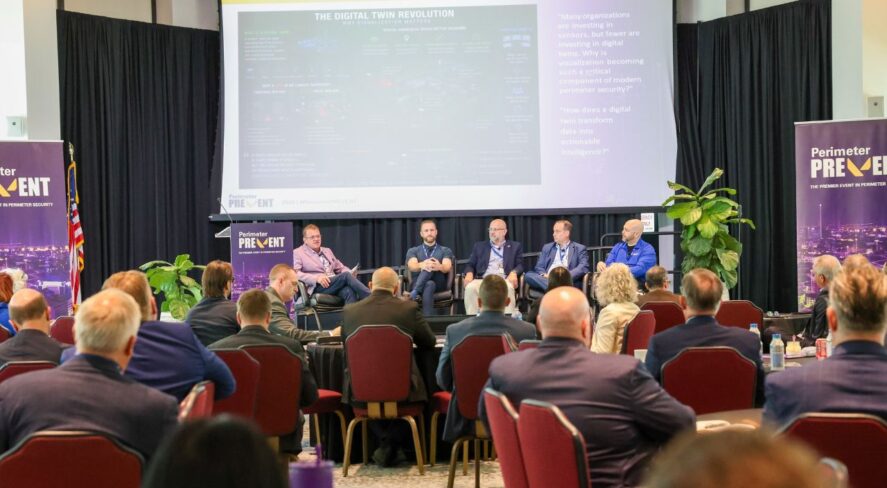
At the 2026 Perimeter PREVENT conference, in a session moderated by Bill Eckard, senior director, public safety, corrections and federal physical security—Americas at Octave, Gerald Becker, vice president, market development and alliances at Quanergy Solutions; Rob Millar, regional manager at FLIR Systems; Eric J. Taylor, regional sales director at Pelco; and Colin Travis, founder of 3-D Security, explored how the convergence of thermal imaging, LiDAR, artificial intelligence-driven video analytics and digital twin visualization is redefining what it means to secure the edge.
The Problem: Why Traditional Perimeter Security Falls Short
The panelists discussed how sites can have cameras, radar, fence sensors and analytics and still not understand what is actually occurring.
“Organizations spend millions securing their perimeters,” said Eckard. “Why are gaps still occurring? We’ve got lots of sensors, but we’re still not making it actionable.”
Many organizations face challenges with limited visibility, delayed detection, false alarms, siloed systems and lack of context. As a result, threats are found too late or not at all, operators are overwhelmed, risk increases and confidence in systems erodes.
“When we’re looking at just the perimeter, we’re not giving ourselves enough time to face threats coming toward us,” said Millar.
The experts argued that what’s needed is complete visibility across the entire perimeter, real-time context and understanding, smarter detection with fewer false alarms and faster, more informed response.
The Technology Evolution
Panelists pointed to new technology advances that can help organizations move beyond isolated sensing toward a layered, intelligent perimeter—one that not only detects intrusion, but understands movement, tracks behavior and visualizes threats in real time.
- Thermal imaging allows you to “see what others can’t” through long-range detection, adverse weather performance, day/night operation and detection of heat, not light. “Weather plays a huge factor in being able to assess threat from farther away,” said Millar. “Thermal gives you an advantage with that.”
- LiDAR technology allows you to see in 3D and know with precision via 3D detection and tracking, elimination of blind spots, precise location and measurement and reduction of false alarms. The technology can detect objects in complex environments; measure accurate distance, height and volume; track movement in 3D space; and provide true situational awareness. “We don’t see like cameras or thermal do—we see in 3D, but with LiDAR you can see space for what it is—zoom in, spin things around and see objects from a true volumetric sense,” said Becker. “You’re now living in the world the threat is in, and when you marry it with cameras and artificial intelligence you can get a full end-to-end solution.”
- AI video analytics can help you gain a complete understanding and turn video into intelligence through deep learning models, providing contextual understanding, reducing false alarms and acting as an operator force multiplier.
The Digital Twin Revolution
The panelists discussed how digital twins can drive better decisions through strong visualization and spatial awareness. A digital twin is a dynamic, real-time digital representation of a physical environment that unifies data from all sensors, systems and sources (e.g., cameras, radar, fence sensors, access control, thermal, LDAR and AI analytics) to provide complete situational awareness.
“A map is a 2D image—a digital twin is a living, breathing, exact replica,” said Becker, while the panelists discussed the technology’s ability to help operators see the full picture, pinpoint events with precision, understand relationships, anticipate and respond.
“We can more accurately and efficiently create designs with digital twins, and you can cover all the layers [and] do virtual walkthroughs,” said Travis. “It’s the exact environment, but you can do everything digitally. It simplifies the process [and] makes it more accurate, efficient and cost-effective.”
Sensor Fusion and the Power of Integration
Becker closed by arguing that, while “each of these technologies is powerful independently,” they are “exponentially better together” to provide consolidated intelligence. Benefits of integrating these sensors together and strengthening redundancy include less uncertainty, reduction of false alarms and the ability to use AI data to reveal what a single sensor cannot see.
Learn more about Perimeter PREVENT here. And access more perimeter security content and resources from SIA here.
 Back to Top