
Beyond Copper Theft: Why Fuel Theft Is Becoming a Critical Utility Security Concern

For electric utilities, physical security has traditionally focused on copper theft, vehicle break-ins, vandalism, substations and critical equipment. But an increasingly attractive target is often sitting in plain sight: the fuel stored in utility yards, service depots, fleet areas and emergency response facilities.
Reports of fuel theft are beginning to surface more frequently in incident reports, local news coverage, police updates and industry discussions. Although many cases involve gas stations, trucking terminals, construction sites, municipal yards or contractor depots, the same risk conditions exist at utility properties: stored fuel, high-value fleet assets, predictable after-hours access patterns and large outdoor sites that can be difficult to monitor continuously. For utilities, this means fuel theft should no longer be viewed as an occasional nuisance or isolated property crime, but as an emerging site security concern with direct implications for reliability and response readiness.
Bulk fuel is not a peripheral asset. Diesel, gasoline and premium fuel support fleet operations, storm response, construction work, vegetation management, backup generation and emergency restoration. Many utilities maintain on-site tanks, pumps, service trucks, generators and storage equipment in yards that may be lightly staffed during the day and largely unattended overnight.
That operating reality is colliding with a volatile fuel market. As gasoline and diesel prices rise or fluctuate sharply, fuel becomes a more attractive target: portable, broadly useful, relatively easy to resell and often stored in predictable locations. For offenders looking for fast value, unattended utility yards can present an appealing opportunity.
Fuel has become attractive because it combines liquidity, utility and anonymity. It does not require a specialized buyer, technical knowledge or a formal resale channel. Once removed from a tank, vehicle, generator or mobile fuel unit, it can be consumed immediately, transferred into other equipment or sold informally with little practical opportunity for recovery. In that sense, fuel sits somewhere between a commodity and a consumable asset: valuable enough to steal, simple enough to move and difficult enough to trace that prevention becomes far more important than recovery.
That attractiveness is amplified by current world conflicts and the pressure they place on energy markets. Conflict in the Middle East, continued disruption linked to Russia’s war in Ukraine, sanctions, attacks on energy infrastructure and uncertainty around critical shipping routes all contribute to volatility in crude oil and refined fuel markets. When those pressures translate into higher prices at the pumps, they are felt by consumers, businesses and utilities alike. For local utilities, the impact shows up in higher fleet costs, contractor pricing, backup generation planning, storm response budgets and the perceived value of every gallon or liter stored behind a fence.
This matters because offenders respond to opportunity and incentive. When fuel prices are high, supplies are uncertain or public attention is focused on energy affordability, stored fuel becomes more than an operating input. It becomes a visible, portable store of value. Utility yards, by their nature, may contain exactly the assets that become more attractive during periods of economic stress: diesel tanks, fleet vehicles, service trucks, portable generators, construction equipment and emergency response supplies. The more essential those assets are to reliability, the more important it becomes to protect them before a loss occurs.
The threat is also becoming more organized. Fuel theft is no longer limited to someone siphoning a small amount from a parked vehicle. Recent incidents across multiple sectors have involved modified vehicles, hidden tanks, cloned cards, skimmers, high-flow pumps and coordinated after-hours activity. In other cases, offenders have damaged tanks directly, creating repair costs, environmental exposure, operational disruption and safety risks that can far exceed the value of the fuel stolen.
For utilities, the real risk is not simply the replacement cost of diesel or gasoline—it is the cascading operational impact. A drained tank can affect fleet readiness. A damaged pump can slow restoration. A spill can trigger environmental response. A compromised yard can expose vehicles, tools, materials and critical equipment. If the incident is discovered only the next morning, the utility is already operating from a position of reaction.
The result is a risk profile that is both familiar and changing. Utilities already understand the consequences of copper theft, vandalism and unauthorized yard access. Fuel theft belongs in that same category, but it also introduces a different challenge: the target is consumable, the loss can be immediate and the operational impact may not be visible until crews, vehicles, or generators are needed.
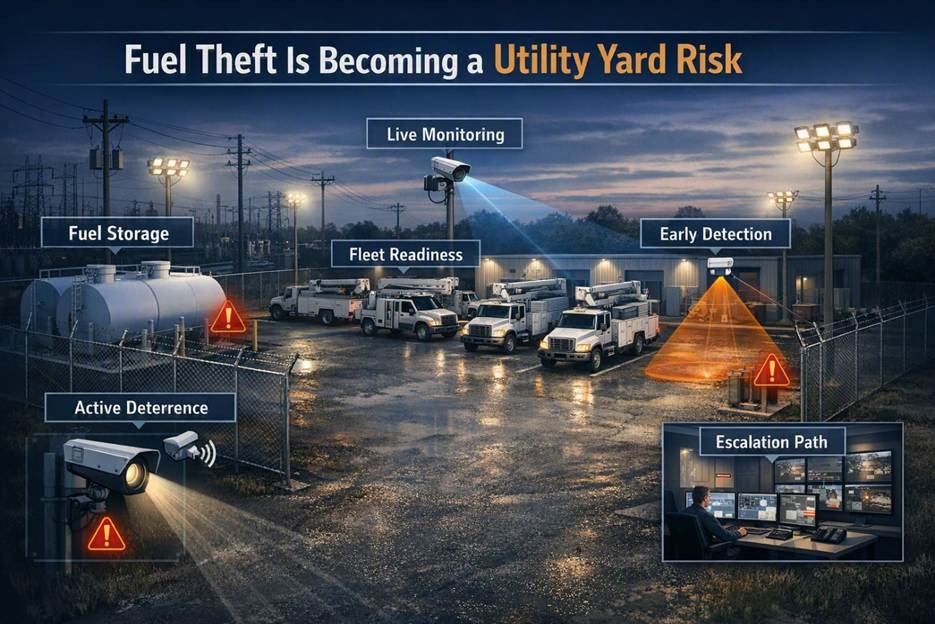
This is where the distinction between passive surveillance and active intervention becomes critical. An unmonitored camera may provide a useful record of what happened. It rarely changes the outcome while the intruder is still on site.
A more resilient approach combines intelligent detection, trained live monitoring, utility-specific response procedures, active deterrence and clear escalation paths to law enforcement or designated utility contacts. The objective is not merely to record a theft. It is to detect suspicious activity early, verify what is happening, intervene while the event is still unfolding and help protect the utility’s ability to operate.
Fuel theft should therefore be treated as part of the broader physical security and business continuity conversation for utilities. Copper theft taught the sector that the value of the stolen material is often the smallest part of the loss. Fuel theft may follow the same pattern: the commodity is attractive, the sites are predictable, the after-hours window is exploitable and the operational consequences can be much larger than the invoice for what disappeared.
The strategic question for utility leaders is straightforward: if fuel, fleet assets, materials and restoration readiness are essential to reliability, why are so many of those assets still protected by systems designed mainly to explain what happened after the fact?
The views and opinions expressed in guest posts and/or profiles are those of the authors or sources and do not necessarily reflect the official policy or position of the Security Industry Association.
This article originally appeared in the Utility Brief, a newsletter presented by the SIA Utilities Advisory Board.
 Back to Top